
This is an old revision of the document!
ELEPHANTS
Class: MAMMALIA
Order: PROBOSCIDEA
Family: ELEPHANTIDAE
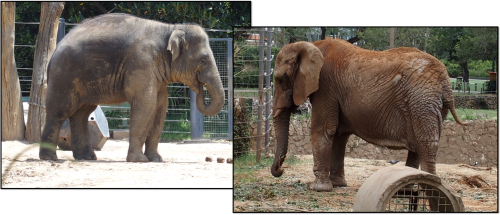

This order of mammals contains the largest land-animals on Earth. Although traditional classification considers two species of elephant - that is, African and Asian elephants, findings in 2000 led to the identification of the African Forest Elephant as a species, making three species in all. The elephant species are spread over two distinct genera - the Asian Elephants of Elephas, with the scientific name of Elephas Maximus, and the African Elephants of Loxodonta. The Savannah Elephant is classified as L. Africana, and its forest relative as L. Cyclotis. In former years, the Asian Elephant's range was widespread across the near-entirety of Asia, including the Middle East, though this has become greatly fragmented. Both African species are larger in size than the Asian species.
I. ELEPHANT EVOLUTION
The fossil record gives a satisfactory record as to how the elephant probably evolved over some 40 or so million years. 37 million years ago, the stubby, short-snouted Moeritherium appeared, built for a life feeding on aquatic plants in the forest. Its branch is not thought to be directly ancestral to elephants, though Moeritherium would have been a close relative of the ancestral elephant. Later on, the lower jaw of these animals would grow greatly in size, as to help brush off vegetation. The deinotheres, which appeared later, had comparatively shorter jaws, like today's elephants. This may be because the deinotheres also had a more specialised trunk, as the leaves they had been feeding on were beginning to lose nutritional value, so a trunk would be useful to cram as much plant food in as possible. Larger elephants may have been selected by nature, as they were better at getting more food, protecting themselves, and storing the food. Elephants would diversify into a number of different genera - Elephants of the Northern Hemisphere would grow a thick layer of fur, leading to the mammoths - a lineage that lasted some 6 million years before a rapid extinction, perhaps caused by a lack of sustainable plant food after the end of the last Ice Age. On some islands, where elephants reached, they would, over millions of years, become greatly smaller in size, as for a lack of resources. The last dwarf-elephant died out some 10,000 years ago, for reasons unclear. For what number of elephants once existed on Earth, only three remain today.