
This is an old revision of the document!
SPECIES PROFILE
GOLDEN LION-TAMARIN
Class: MAMMALIA
Order: PRIMATA
Family: CEBIDAE
Genus: LEONTOPITHECUS
Species: ROSALIA
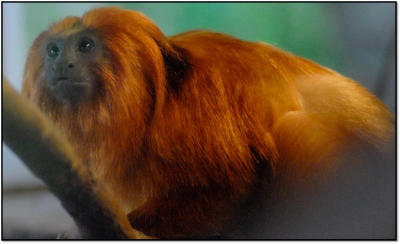
This small tamarin is one of four species in its genus. Perhaps it is also the best known species of tamarin – as it is covered in coat of uniform reddish-yellow fur, giving its name. Debate has arisen as to the true sister species of the Golden Lion-Tamarin – as to whether this is represented by the Black Lion-Tamarin, with jet-black fur [but a golden rump], or the Golden-Headed Lion-Tamarin – which possesses a golden head, but black fur. The tamarins serve as a living example of speciation – where the Black Lion-Tamarin and Golden Lion-Tamarin represent two evolutionary extremes, the Golden-Headed Lion-Tamarin and Black-Headed Lion-Tamarin perhaps represent a genetic midway point. This speciation also appears to have been rather rapid – it is not thought to have exceeded 1 million years. Lion-tamarins are so named for the sizable ‘mane’ that they possess on their face. As do other species of Tamarin, most of the time of the Golden Lion-Tamarin is spent above the ground in trees, and the species also sleeps in trees. Their calls may have from 13 to 27 syllables, and gradually increase as the call elongates. Their diet also consists of what is found in the trees as well – namely fruits, insects, and lizards. Much of this is found inside the tree itself, and is snared in by the long fingers. An omnivorous animal, many captive Golden Lion-Tamarins at one time suffered from protein and Vitamin D3 deficiencies, and their diets were largely fruit-based. Hence, captive tamarins may have a diet consisting largely of supplemented pellet feed – marmoset chow, as well as a more balanced diet. If the chow is not sufficient in protein, additional sources, such as eggs or dairy [i.e. cottage cheese, milk] may be added. It is also important that the food items provide social stimulation between the animals. The males slightly larger than the females, both sexes are roughly 25 centimetres in length, and weigh from 480 to 680 grams. The gestation period of the species is about 5 months – and this typically results in twins. As are most primates, the species is monogamous. Even when mature at 15 months, many tamarins stay close to their parents, forming an extended family group, with older siblings taking care of the younger siblings.
Ever since Europeans first explored South America, the fur of the Golden Lion-Tamarin has proven to be attractive – leading to export of animals. This, combined with the destruction of forest for agricultural purposes has led to the Golden Lion-Tamarin becoming one of the most endangered of all primates – by the early 1970s, it was thought that only 200 or so animals survived, and with a poor success rate in captivity, some would imagine extinction not only possible, but in certainty. Later on, breeding of Golden Lion-Tamarins in captivity would be taken seriously, and several of these animals would be released to Brazil. By 2003, the species was listed as ‘Endangered’ as opposed to ‘Critically Endangered’, as a sufficient population was fostered. The wild population of Golden Lion-Tamarins would rise to around 3,600 – a third of which were direct descendants of captive animals. Several zoos in Europe and North America today, such as the Smithsonian, Bristol, and Jersey zoos keep the species as a flagship species for conservation of South American ecosystems. The unauthorised exportation and trade of the species as a pet has been made illegal since 1970, though this illegal trade is known to continue. Even today, the species is still at risk of extinction largely because of destruction of its rainforest habitat. In recent years, The Yellow Fever disease has been detected in the species, and deaths have been recorded since 2018. The virus appears to have taken on an epidemic form in the animals, with the population dropping from 3,600 to 2,500. A vaccine, the production of which assisted by the Philadelphia Zoo, has been created for the species, and over 100 Golden Lion-Tamarins so far have been vaccinated against Yellow Fever. If this vaccine proves effective, the Golden Lion-Tamarin could lead a true success story of conservation.